
Today was, as you might have guessed, the best day ever. Sorry, I've been kind of slacking on the keeping you updated on what I'm doing in culinary school thing. Truthfully, I'm usually exhausted at the end of the day, and then I have to do homework, and posting just takes me so long that I haven't been keeping up. But today was so fantastic that I can't keep it to myself.
So what did we do today?, you're probably wondering.
Answer: Eggs, Cheese, & Dairy. Happy days. I will just have to look back on this and remember today when we get to butchering, which will not be the best day.
So we started out by making sweet souffles (as opposed to savory). Students chose between a Grand Marnier souffle or chocolate; I chose chocolate (obvi).

Before the oven
As a seasoned savory souffle maker, I found the process quite straight forward, but I will have to experiment and adapt the recipe a bit before I post it because its written in "cooking school" quantities--i.e., more than you would ever make at home. However, both the chocolate souffle and Grand Marnier Souffle were great, particularly the Grand Marnier, as it turned out (I think the chocolate souffle needs more chocolate...or at least that's one chocoholic's opinion!)

My baby coming out of the oven


Digging in
Next: Eggs. First we watched Chef John demonstrate about eight different ways to prepare eggs, all beautiful and delicious.

Chef John shows us how it's done
The most interesting to me were shirred eggs, which were eggs cracked into a ramekin filled with pieces of thinly sliced meat (I think it was ham?), dobbed with (lots of) butter, then baked until the eggs were adequately set. There was so much going on while he was demonstrating that I don't know exactly how long or what temperature, but if I had to guess I'd say about 8 minutes at 375 or 400? I will have to get back to you on the details of this.

Shirred Eggs
He also did an individual leek, goat cheese and pesto frittata, which was awesome, and demonstrated both French and American style omelets, which are actually quite different.
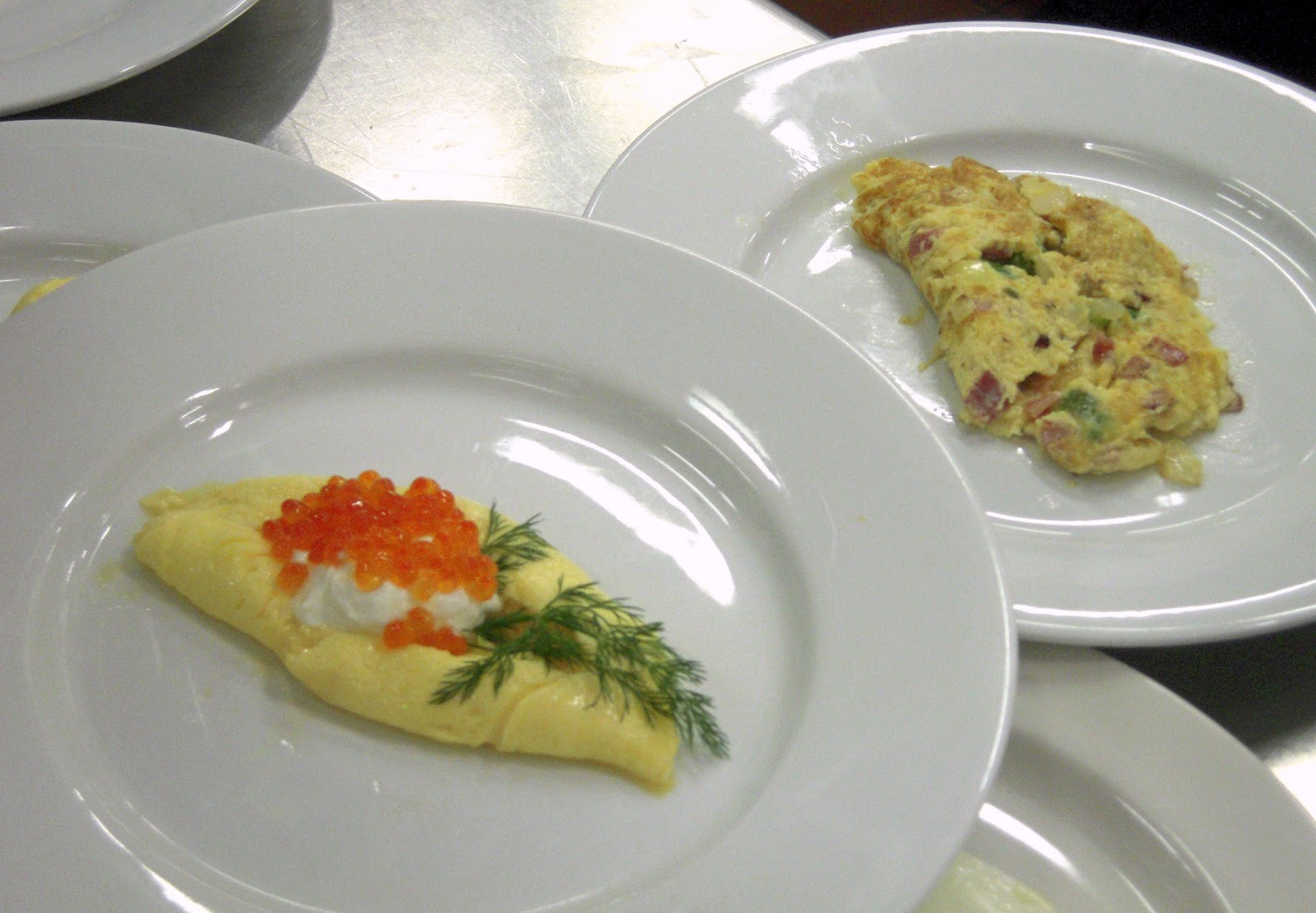
French omelet with sour cream and caviar (left); American "Denver" omelet (right)
The most interesting thing besides the shirred eggs was a French style dessert omelet, which was just your basic French omelet (I can't do it justice here, you really just need to see someone doing it, but basically you start out in a pan over medium heat, add 2 beaten eggs, then move them around with a spatula almost like you're scrambling the egg, then , when it's mostly set, you leave it alone (except a little bit of jiggling to make sure it isn't sticking or browning), until it's totally set, then you fold one third over, and as you slide it out of the pan you fold the other third over, so the top is nice and smooth. So once John made a perfect French omelet he filled it with apricot jam before folding it, and sprinkled it with confectioner's sugar, then he took a hot metal skewer (that he had stuck in the gas burner for a minute) and seared three diagonal lines through the sugar. Beautiful and delicious! It had never occurred to me to do a sweet omelet, but it was delish :)

Sweet apricot filled omelet

The egg dishes multiply faster than bunnies
After John whipped out all these beautiful egg dishes, we set to perfecting our own eggs. After three takes I produced one decent French omelet, and I also practiced my scrambled eggs (although to be honest, I think I'm already pretty good at those--they are my fave), and then I practiced my over easies, including flipping them with just (several) flick(s) of my wrist. Here's what I can tell you about flipping eggs using just your wrist: "Don't be afraid!" (in your best Julia Child voice). And do it over the sink, just in case you miss (but "never apologize!"). My first one I did over too high heat, and it got too crispy and brown, but my second one was quite pretty. The biggest take away lessons from all of this egg frying/scrambling/omeleting/frittata-ing?

A sampling of my egg dishes: Over medium, scrambled, and 3 attempts
at French omelets, getting progressively better from right to left
1. Use the right size pan. (We were doing all of these individually, in 6 or 7-inch pans, like you would at an upscale restaurant).
2. Make sure the pan is ridiculously non-stick and/or well seasoned
3. Only cook over moderate heat--browning isn't ideal, except for some American-style omelets
4. Clarified butter. And lots of it. (See pic of John, above. That measuring cup of yellow stuff--butter.) Clarified butter is regular butter without the milk solids. To make it you can either melt a hunk of butter gently, then let the milk solids (the white part), sink to the bottom, then skim off from the top. The part you want to use is the very clear and pure yellow part. It is ideal for eggs because it doesn't brown or smoke, so it's forgiving if you overheat your pan, and all that jazz. You can make your own by melting like, a pound of butter then letting the white parts sink and skimming off the yellow part (we go through it like water in cooking class, so we're making our own, often). Alternatively, you can find in ethnic markets and better supermarkets as ghee, aka, Indian clarified butter.
Ooh, and I poached the most beautiful egg ever, and made it into an egg Benedict sandwich, which was fantastic. If you are like the old me (before I learned how to poach eggs), you probably don't like poaching eggs, because they get all runny and weird in the water. But, I found out how to do it well, and I have to say, my first egg was even prettier than Chef John's. So, here are the tricks:

Egg Benedict. I was so excited I bit into it before I took the picture.
Sorry. That black thing on top is a truffle. Seriously fancy here, people.
1. For every quart of poaching water, you add 1/4 cup of white vinegar. This sounds like a lot, but it's not, and it's crucial, (you won't even taste it--promise). DON'T put any salt in your water, it will make the whites run.
2. If you're not using the poached eggs right away, have a bowl of iced salted water set up. When your eggs are doing cooking, transfer them into the cold water, which will stop the cooking and keep then moist.
3. Pre-crack your eggs into a teacup or other small vessel and use it to slip the egg into the water. This way it will go in as one whole blob, and you'll avoid having too much "spread" of the whites.
4. Use extremely fresh Grade A eggs--these are the firmest--again, less spread.
5. Use poaching water that is simmering, just on the verge of a boil. Barely simmering water isn't quite hot enough, and boiling water will disrupt the eggs.
6. Timing--Most people like eggs poached between 2 1/2 and 3 minutes. If you are poaching multiple eggs in the same pot, add 10 seconds per egg for each one in the pot (ex., if you're poaching 4 "2 1/2" minute eggs, total cooking time should be about 3 minutes, because you add 10 seconds for each additional egg). Being the yolk-hating weirdo that I am, I prefer my egg poached closer to 5 minutes, but if you follow the first guidelines--vinegar in the water, proper simmering temp, and pre-cracking your eggs--no matter how long you cook them, they should come out well.
If your whites do end up spreading a lot, it's totally acceptable to trim up the whites to make them look prettier--or not, whatevs. I won't judge if you like to quantity over looks.
So, yeah, that's a lot about eggs. I probably ate at least half a dozen today. Good thing I don't have a cholesterol problem (yet). Hopefully a few of these tricks will help you next time you need to cook an egg, and when I get some more specifics on the souffles, you will be the first to know, I promise!
Stay tuned for part 2 of BEST DAY EVER: Wine and Cheese pairing. Heaven!


